
You've probably heard that search engine optimisation is essential for your business, but what does it actually mean? Many business owners mistakenly believe SEO is a quick fix or simply about paying for higher rankings. In reality, SEO helps increase organic search visibility by systematically improving how search engines understand and value your website. This guide will demystify SEO, explaining exactly how it works and providing actionable strategies you can implement to boost your online presence and attract qualified traffic without relying on paid advertising.
Table of Contents
- Key takeaways
- Understanding what search engine optimisation is
- The main components of SEO and how they work together
- Common SEO strategies businesses should implement
- Measuring SEO success and ongoing optimisation
- Enhance your SEO with expert guidance and tools
- What is search engine optimisation and how does it help my business?
Key Takeaways
| Point | Details |
|---|---|
| SEO purpose | SEO aims to improve a site’s ranking in organic search results by making it easier for search engines to understand and value its content. |
| Sustainable traffic | Organic search traffic is unpaid and builds lasting authority that continues long after content is published, unlike paid advertising which stops when spend ends. |
| Three SEO pillars | Effective optimisation balances on page, off page, and technical optimisation to improve visibility and user experience. |
| Ongoing optimisation | Success relies on continual monitoring, adaptation, and understanding user intent rather than one off fixes. |
| Compounding momentum | Small improvements build over time, creating momentum that makes ranking gains harder for competitors. |
Understanding what search engine optimisation is
Search engine optimisation is the practice of improving your website to rank higher in organic search results when potential customers search for products, services, or information related to your business. Unlike paid advertising, organic traffic comes from unpaid search listings, making it a sustainable and cost-effective way to attract visitors over time.
The primary distinction between organic and paid search is crucial for your marketing budget. Paid search delivers immediate visibility but stops the moment you stop paying. Organic search builds lasting authority that continues generating traffic long after you've published optimised content. This fundamental difference makes SEO an investment rather than an expense.
Effective SEO achieves several interconnected objectives:
- Drives qualified traffic from people actively searching for what you offer
- Builds website authority and trustworthiness in your industry
- Enhances user experience through faster loading, better navigation, and relevant content
- Increases conversion rates by matching visitor intent with appropriate solutions
These objectives work together through three main components. On-page SEO focuses on optimising individual pages with relevant keywords, compelling content, and proper formatting. Off-page SEO builds your website's reputation through quality backlinks and brand mentions across the web. Technical SEO ensures search engines can properly crawl, index, and understand your site structure.
Pro Tip: Think of SEO as building a reputation rather than gaming a system. Search engines reward websites that genuinely serve user needs with valuable, well-structured content. Focus on creating resources your audience actually wants to find, and optimisation becomes much more intuitive.
The beauty of SEO lies in its compounding nature. Each improvement you make builds upon previous efforts, creating momentum that becomes increasingly difficult for competitors to overcome. When you publish a well-optimised article today, it can continue attracting visitors for years, unlike a paid advertisement that disappears when your budget runs out.
Search engines use sophisticated algorithms to evaluate hundreds of factors when determining rankings. Whilst the exact formulas remain proprietary, the underlying principle stays consistent: deliver the most relevant, trustworthy, and useful results for each query. Your SEO efforts should align with this principle rather than trying to manipulate rankings through shortcuts.
For businesses just starting their digital journey, Digital Sphere offers comprehensive SEO services that integrate seamlessly with website development and digital marketing strategies. This holistic approach ensures every element of your online presence works together to maximise visibility and conversions.
The main components of SEO and how they work together
Successful SEO requires balancing three interconnected pillars, each contributing unique value to your overall search performance. SEO encompasses on-page content, link-building strategies, and site technical health to create a comprehensive approach that search engines reward with higher rankings.
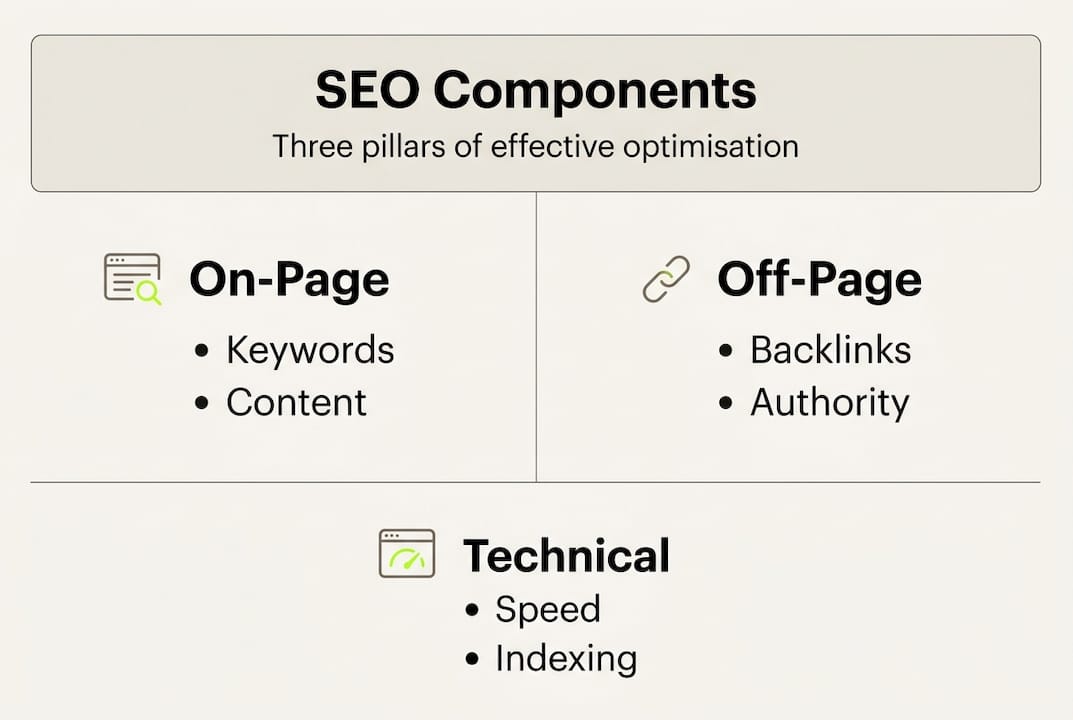
On-page SEO focuses on elements you directly control within your website. This includes strategically placing relevant keywords in titles, headings, and body content whilst maintaining natural readability. Meta descriptions, although not a direct ranking factor, influence click-through rates by providing compelling previews in search results. Image alt text serves dual purposes: improving accessibility for visually impaired users and helping search engines understand visual content. Internal linking creates pathways between related pages, distributing authority throughout your site whilst helping visitors discover more valuable resources.

Off-page SEO builds your website's reputation and authority across the broader internet. Quality backlinks from reputable websites signal to search engines that others trust your content enough to reference it. Not all links carry equal weight, however. A single link from an authoritative industry publication provides far more value than dozens of links from low-quality directories. Social signals, whilst not direct ranking factors, amplify content reach and can indirectly influence SEO by increasing visibility and earning natural backlinks. Brand mentions, even without links, help establish your business as a recognised authority in your field.
Technical SEO ensures search engines can efficiently crawl, index, and understand your website. Site speed directly impacts both user experience and rankings, with slow-loading pages frustrating visitors and receiving lower rankings. Mobile-friendliness has become non-negotiable, as most searches now occur on mobile devices. Proper site structure with logical navigation and clear hierarchies helps search engines understand content relationships and importance. XML sitemaps guide crawlers to important pages, whilst robots.txt files prevent indexing of irrelevant sections.
| SEO component | Primary focus | Key benefit |
|---|---|---|
| On-page | Content and keyword optimisation | Directly improves relevance for target queries |
| Off-page | Backlinks and brand authority | Builds trust and credibility signals |
| Technical | Site performance and accessibility | Enables proper indexing and positive user experience |
These components don't operate in isolation. Outstanding content (on-page) attracts natural backlinks (off-page), whilst technical excellence ensures both users and search engines can access that content efficiently. Neglecting any single pillar undermines the others, creating weaknesses competitors can exploit.
Pro Tip: Start with technical foundations before investing heavily in content creation. Publishing brilliant articles on a technically flawed website wastes effort, as search engines may struggle to properly index and rank your content. Fix crawl errors, improve site speed, and ensure mobile responsiveness first.
Local businesses benefit particularly from optimising their Google Business Profile, which bridges on-page, off-page, and technical elements. A well-maintained profile improves local search visibility, provides valuable backlinks, and ensures accurate business information across Google's ecosystem.
The synergy between these components creates exponential rather than additive results. A technically sound website with mediocre content underperforms, as does exceptional content on a technically broken site. When all three pillars work in harmony, your website becomes a formidable competitor in search results, attracting qualified traffic that converts into customers.
Common SEO strategies businesses should implement
Implementing effective SEO requires a structured approach that addresses both immediate opportunities and long-term growth. Businesses benefit most from focusing on keyword research, quality content, and technical optimisation as foundational strategies that deliver consistent results.
-
Conduct thorough keyword research to understand exactly what your target audience searches for. Use tools to identify terms with sufficient search volume and manageable competition. Focus on long-tail keywords (phrases of three or more words) that indicate specific intent, as these often convert better than broad, competitive terms. Consider search intent behind each keyword: are users looking for information, comparing options, or ready to purchase? Match your content to this intent.
-
Create high-quality, comprehensive content that genuinely addresses user needs. Search engines increasingly prioritise content depth and usefulness over keyword density. Answer questions thoroughly, provide actionable insights, and include relevant examples that demonstrate expertise. Update existing content regularly to maintain accuracy and relevance, as fresh content signals ongoing value to search engines.
-
Optimise technical elements that enable search engines to efficiently crawl and index your site. Implement structured data markup to help search engines understand content context and potentially earn rich snippets in results. Ensure proper URL structure with descriptive, keyword-rich paths rather than cryptic parameters. Create and submit XML sitemaps to guide crawlers to important pages.
-
Build authoritative backlinks through ethical, sustainable methods. Create linkable assets like original research, comprehensive guides, or useful tools that naturally attract references. Engage in strategic outreach to relevant publications and industry websites. Avoid link schemes or purchasing links, as these violate search engine guidelines and risk penalties.
-
Optimise for local search if you serve specific geographic areas. Claim and fully complete your Google Business Profile with accurate information, compelling descriptions, and regular updates. Encourage satisfied customers to leave reviews, as these influence both rankings and conversion rates. Ensure consistent business information (name, address, phone number) across all online directories.
-
Improve user experience signals that indirectly impact SEO. Reduce bounce rates by ensuring content matches search intent and provides immediate value. Enhance site navigation so visitors easily find related information. Optimise page layouts for readability with clear headings, short paragraphs, and visual breaks.
-
Monitor performance metrics and adapt strategies based on data. Track keyword rankings to identify opportunities and threats. Analyse organic traffic patterns to understand which content resonates with your audience. Review conversion rates to ensure traffic quality matches quantity.
Pro Tip: Prioritise creating one exceptional, comprehensive resource over ten mediocre pages. Search engines increasingly favour authoritative content that thoroughly covers topics, making depth more valuable than breadth. A single well-researched guide can outrank dozens of shallow articles.
Implementing these strategies requires consistent effort over months rather than days. SEO rewards patience and persistence, with compounding benefits emerging as your website builds authority. Quick wins exist, particularly in technical optimisation and low-competition keywords, but sustainable success comes from systematic improvement across all areas.
Avoid common mistakes like keyword stuffing, which creates poor user experience and risks penalties. Don't neglect mobile optimisation, as mobile-first indexing means search engines primarily evaluate your mobile site. Resist the temptation to copy competitor content, as duplicate content provides no unique value and may incur penalties.
Measuring SEO success and ongoing optimisation
Effective SEO requires continuous measurement and refinement based on performance data. Tracking metrics like organic traffic, rankings, and conversions provides the insights needed to identify what's working, what needs improvement, and where new opportunities exist.
Organic traffic volume represents the most fundamental SEO metric, showing how many visitors find your site through unpaid search results. Track overall trends whilst drilling into specific pages to identify top performers and underachievers. Sudden drops often indicate technical issues or algorithm updates requiring immediate attention, whilst steady growth confirms your strategies are working.
Keyword rankings reveal your visibility for target search terms. Monitor both primary keywords you're actively optimising for and unexpected terms driving traffic. Ranking improvements validate your optimisation efforts, whilst declines signal increased competition or content that needs refreshing. Remember that rankings fluctuate naturally, so focus on trends over weeks and months rather than daily changes.
Bounce rate and time on page indicate content quality and relevance. High bounce rates suggest visitors aren't finding what they expected, pointing to misaligned keywords or disappointing content. Longer time on page generally indicates engaging, valuable content, though this varies by content type (quick answers versus comprehensive guides).
Conversion rate transforms SEO from a vanity metric into business value. Track how organic visitors complete desired actions: purchases, enquiries, newsletter signups, or resource downloads. High traffic with low conversions suggests attracting the wrong audience or poor conversion optimisation.
| Metric | What it measures | Why it matters |
|---|---|---|
| Organic traffic | Visitors from unpaid search | Shows overall SEO effectiveness and reach |
| Keyword rankings | Position in search results | Indicates visibility for target terms |
| Bounce rate | Percentage leaving after one page | Reveals content relevance and quality |
| Conversion rate | Visitors completing desired actions | Measures business impact and ROI |
| Page load time | Speed of content delivery | Affects both rankings and user satisfaction |
Analytics tools provide the data infrastructure for measuring these metrics. Google Analytics tracks traffic sources, user behaviour, and conversion paths. Google Search Console reveals search performance, indexing status, and technical issues. Combine these with rank tracking tools for comprehensive visibility into SEO performance.
SEO is never truly finished because search algorithms, competitor strategies, and user behaviour constantly evolve. Regular content updates keep information accurate and signal ongoing relevance to search engines. Algorithm updates may require strategy adjustments to maintain rankings. New competitors entering your space necessitate defensive optimisation to protect existing positions.
Common pitfalls undermine otherwise solid SEO efforts:
- Ignoring user experience in pursuit of rankings creates technically optimised sites that fail to convert visitors
- Allowing content to become outdated reduces relevance and trustworthiness over time
- Focusing exclusively on rankings whilst neglecting traffic quality attracts visitors who never convert
- Neglecting mobile experience alienates the majority of users and harms rankings
- Failing to monitor technical health allows crawl errors and broken links to accumulate
Establish a regular optimisation schedule rather than sporadic efforts. Monthly reviews of analytics identify trends and opportunities. Quarterly content audits ensure information remains current and comprehensive. Annual strategy assessments realign SEO efforts with evolving business goals and market conditions.
Successful long-term SEO balances consistency with adaptability. Maintain core strategies that deliver results whilst remaining flexible enough to capitalise on new opportunities or respond to algorithm changes. This approach builds sustainable organic visibility that continuously drives qualified traffic and business growth.
Enhance your SEO with expert guidance and tools
Whilst understanding SEO fundamentals empowers you to make informed decisions, implementing comprehensive strategies often benefits from professional expertise and specialised tools. Digital Sphere offers tailored SEO consulting that integrates seamlessly with your broader digital strategy, ensuring every element of your online presence works together to maximise visibility and conversions. Their approach combines technical audits, content strategy, and ongoing optimisation to deliver measurable results.
For businesses beginning their SEO journey, the SEO ebook provides actionable insights and step-by-step guidance you can implement immediately. It distills complex concepts into practical frameworks designed specifically for business owners and marketers.
The customer dashboard gives you real-time visibility into your SEO progress, tracking key metrics and highlighting opportunities for improvement. This transparency ensures you always understand how your investment translates into business results. Professional assistance accelerates outcomes by avoiding common pitfalls and leveraging proven strategies refined across hundreds of successful projects.
What is search engine optimisation and how does it help my business?
What exactly is SEO and why does it matter for my business?
SEO is the practice of optimising your website to rank higher in organic search results, making it easier for potential customers to find you when searching for relevant products or services. It matters because organic search often represents the largest source of qualified website traffic, delivering visitors actively looking for what you offer without ongoing advertising costs.
How long does it take to see results from SEO efforts?
Most businesses begin seeing measurable improvements within three to six months, though competitive industries may require longer. SEO builds momentum over time, with compounding benefits emerging as your site gains authority. Quick wins exist in technical fixes and low-competition keywords, but sustainable success requires consistent effort over many months.
Can SEO help my local business attract nearby customers?
Absolutely. Local SEO specifically targets customers in your geographic area through optimised Google Business Profile listings, location-specific content, and local citations. This proves especially valuable for businesses serving specific regions, as it connects you with high-intent customers ready to visit or purchase locally.
How much should I invest in SEO for my business?
Investment varies based on your industry competitiveness, business goals, and current website state. Many businesses start with foundational optimisation costing a few hundred pounds monthly, scaling investment as they see returns. Consider SEO a long-term investment rather than an expense, as benefits compound over time and continue delivering value long after initial implementation.
What's the difference between SEO and paid search advertising?
SEO focuses on earning organic rankings through optimisation, delivering sustained traffic without ongoing costs per click. Paid search provides immediate visibility but requires continuous spending to maintain. Most successful businesses use both strategically: paid search for immediate results and testing, SEO for long-term sustainable growth and lower customer acquisition costs.