
Many entrepreneurs believe traditional marketing alone can sustain their business, but 71% of customers now expect an online presence. Digital marketing encompasses far more than posting on social media or running ads. It's a strategic ecosystem of channels and methods that work together to build your brand, attract customers, and drive measurable growth. This guide breaks down what digital marketing truly is, explores the core channels you need to know, and shows you how to apply these fundamentals effectively to enhance your online presence and achieve tangible business results.
Table of Contents
- Key takeaways
- What digital marketing is and why it matters
- Core digital marketing channels and methods
- How to apply digital marketing effectively for your small business
- Measuring effectiveness and scaling your digital marketing efforts
- Explore digital marketing solutions from Digital Sphere
- Frequently asked questions
Key Takeaways
| Point | Details |
|---|---|
| Precise targeting | Digital marketing allows targeting of specific demographics and tracking of every click, enabling real time optimisation based on performance data. |
| Measurable results | Unlike traditional methods, digital marketing provides analytics and metrics that show what works and what does not. |
| Small business advantage | Digital marketing offers cost efficient targeting and scalable growth even for limited resources. |
| Core channels and methods | SEO, content marketing and social media foundations should be integrated with other tactics to build a cohesive strategy. |
What digital marketing is and why it matters
Digital marketing is the practice of promoting products, services, or brands through online channels to engage customers where they spend their time. Unlike traditional marketing that relies on billboards, print ads, or television spots, digital marketing leverages websites, search engines, social media platforms, email, and mobile apps to reach audiences.
The fundamental difference lies in precision, measurement, and scalability. Traditional marketing casts a wide net with limited ability to track who sees your message or how they respond. Digital marketing lets you target specific demographics, interests, and behaviours whilst tracking every click, conversion, and pound spent. You can adjust campaigns in real time based on performance data, something impossible with a printed flyer or radio spot.
For small businesses, this levels the playing field. You're not competing on budget size but on strategy and execution. Digital marketing offers precise targeting, measurable results, and scalable costs, making it accessible even with limited resources. A local bakery can reach customers within a five-mile radius through geo-targeted ads. A consultant can build authority through content marketing without expensive magazine placements.
The business case is compelling:
- Lower cost per acquisition compared to traditional advertising
- Ability to test and optimise campaigns continuously
- Direct engagement with customers through comments, messages, and reviews
- Detailed analytics showing exactly what works and what doesn't
Yet challenges exist. The digital landscape evolves rapidly, with platform algorithms changing and new channels emerging. Many entrepreneurs feel overwhelmed by the options or spread themselves too thin trying to be everywhere at once. The key is understanding which channels align with your customers' habits and focusing your efforts strategically.
"The best marketing doesn't feel like marketing. It provides value, builds relationships, and earns trust before asking for the sale."
Exploring Digital Sphere services can help you navigate these complexities with expert guidance tailored to your business needs.
Core digital marketing channels and methods
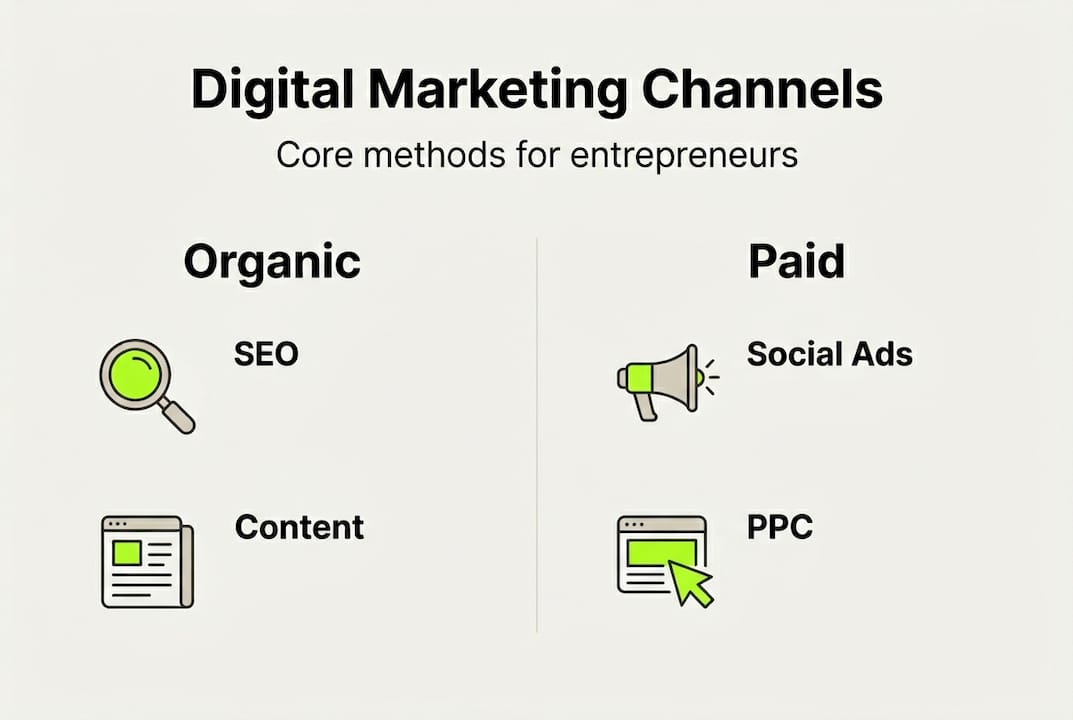
Understanding the primary digital marketing channels helps you build a cohesive strategy rather than random tactics. Each channel serves distinct purposes and works best when integrated with others.

Search engine optimisation (SEO) improves your website's visibility in organic search results. When potential customers search for solutions you provide, SEO ensures your site appears prominently. This builds long-term traffic without ongoing ad spend, though it requires patience and consistent effort.
Content marketing creates valuable information that educates, entertains, or solves problems for your audience. Blog posts, videos, podcasts, and infographics establish your expertise whilst attracting customers naturally. Quality content supports SEO, provides social media fuel, and nurtures relationships over time.
Social media marketing builds brand awareness and engagement on platforms like Facebook, Instagram, LinkedIn, and TikTok. Each platform attracts different demographics and content styles. Instagram suits visual brands, LinkedIn serves B2B companies, and TikTok reaches younger audiences through short videos.
Email marketing maintains direct communication with customers and prospects. Despite being one of the oldest digital channels, email consistently delivers strong ROI. It's perfect for nurturing leads, announcing promotions, and building loyalty through personalised messages.
Pay-per-click (PPC) advertising places your ads on search engines or social platforms, charging only when someone clicks. Google Ads and Facebook Ads offer sophisticated targeting options, letting you reach specific audiences based on demographics, interests, and behaviours. Results come quickly, making PPC ideal for promotions or testing new markets.
Influencer marketing partners with trusted voices in your industry to expand reach and credibility. Micro-influencers with smaller, engaged followings often deliver better results than celebrities for small businesses.
| Channel | Primary use | Typical cost | Key benefit |
|---|---|---|---|
| SEO | Long-term organic traffic | Time investment | Sustainable visibility |
| Content marketing | Education and trust-building | Medium | Authority and engagement |
| Social media | Brand awareness and community | Low to medium | Direct customer interaction |
| Email marketing | Customer retention | Low | High ROI and personalisation |
| PPC advertising | Quick targeted traffic | Variable per click | Immediate measurable results |
| Influencer marketing | Reach expansion | Variable | Credibility through association |
Pro Tip: Choose channels based on where your target customers spend time, not where you feel most comfortable. Research customer behaviour first, then focus on two or three channels to master before expanding.
Exploring digital marketing solutions from Digital Sphere provides integrated approaches that combine multiple channels for maximum impact.
How to apply digital marketing effectively for your small business
Knowing the channels is one thing. Applying them strategically is another. Follow these steps to build a practical digital marketing plan that drives real growth.
-
Define clear business goals and identify your ideal customer. What specific outcomes do you want? More website traffic, email subscribers, product sales, or service enquiries? Who exactly are you trying to reach? Create detailed customer profiles including demographics, challenges, and online behaviour.
-
Research where your customers spend time online. Do they search Google for solutions? Scroll Instagram during lunch? Check LinkedIn for professional insights? Use surveys, customer interviews, and analytics to understand their digital habits.
-
Select two or three channels that align with customer behaviour and your resources. Starting small lets you learn and refine before expanding. A B2B consultant might focus on LinkedIn and content marketing. A local retailer might prioritise Instagram and Google My Business.
-
Create content that addresses customer needs and questions. Map content to different stages of the buyer journey. Awareness stage content educates about problems. Consideration stage content compares solutions. Decision stage content highlights your specific offering.
-
Establish a consistent publishing schedule and stick to it. Consistency builds trust and signals reliability to both audiences and algorithms. Better to post quality content weekly than mediocre content daily.
-
Track performance metrics from day one. Set up Google Analytics, platform insights, and conversion tracking. Knowing what works lets you double down on success and cut what fails.
-
Engage with your audience authentically. Respond to comments, answer questions, and participate in conversations. Digital marketing is a dialogue, not a broadcast.
Common pitfalls to avoid include spreading resources too thin across too many channels, creating content without understanding audience needs, neglecting to measure results, and expecting overnight success. Digital marketing requires precise targeting and measurement to deliver sustainable results.
Pro Tip: Treat your first three months as a learning phase. Test different content types, posting times, and messages. Analyse what resonates, then refine your approach based on real data rather than assumptions.
Access digital marketing strategy resources for templates and frameworks that simplify planning and execution.
Measuring effectiveness and scaling your digital marketing efforts
Data separates successful digital marketing from expensive guesswork. Understanding key performance indicators (KPIs) and how to interpret them enables smart decisions about where to invest time and money.
Start by identifying metrics that align with your business goals. Website traffic shows visibility. Bounce rate indicates content relevance. Conversion rate measures how many visitors take desired actions. Email open rates reveal subject line effectiveness. Social engagement signals content resonance.
| KPI | What it measures | How to track |
|---|---|---|
| Website traffic | Visitor volume and sources | Google Analytics |
| Conversion rate | Percentage completing desired actions | Analytics goals and e-commerce tracking |
| Cost per acquisition | Amount spent to gain one customer | Ad platform data divided by conversions |
| Email open rate | Percentage opening your emails | Email platform analytics |
| Social engagement | Likes, comments, shares, saves | Platform insights dashboards |
| Return on ad spend | Revenue generated per pound spent on ads | Revenue divided by ad spend |
Google Analytics provides comprehensive website data including traffic sources, user behaviour, and conversion tracking. Social media platforms offer built-in analytics showing post performance, audience demographics, and engagement trends. Email platforms track opens, clicks, and conversions. PPC platforms display detailed campaign metrics including impressions, clicks, and cost per result.
Interpreting this data reveals what's working. If blog posts about a specific topic drive more conversions than others, create more content on that theme. If Instagram Stories generate more engagement than feed posts, shift your effort accordingly. If certain email subject lines achieve higher open rates, apply those principles to future campaigns.
Best practices for data-driven optimisation:
- Review analytics weekly to spot trends early
- Compare performance month over month to measure growth
- Test one variable at a time to isolate what drives results
- Document what you learn to build institutional knowledge
- Set benchmarks based on your own historical data, not industry averages
Scaling means doing more of what works whilst maintaining quality and efficiency. If content marketing drives results, increase publishing frequency or expand into new formats. If PPC delivers positive ROI, gradually increase budget whilst monitoring cost per acquisition. Measurement and scalable costs make digital marketing sustainable for growing businesses.
Pro Tip: Start with small budget tests before committing significant resources. A £100 ad test reveals whether a channel works for your business before you invest £1,000. Scale gradually based on proven results, not hunches.
Leverage digital marketing analytics tools that integrate data from multiple channels into unified dashboards for clearer insights.
Explore digital marketing solutions from Digital Sphere
Applying digital marketing fundamentals takes time, expertise, and consistent effort. Digital Sphere specialises in delivering tailored digital marketing strategies that help small businesses and entrepreneurs build strong online presence without the overwhelm. Our comprehensive services integrate SEO, content creation, social media management, and targeted advertising campaigns designed specifically for your business goals and audience.
Whether you're just starting your digital journey or looking to scale existing efforts, our team combines AI-driven insights with expert human strategy to maximise results. Access our customer dashboard for real-time campaign tracking and performance insights. Download our digital marketing ebook for actionable frameworks you can implement immediately.
Partnering with experienced professionals amplifies your effectiveness whilst freeing you to focus on running your business. Explore how Digital Sphere can accelerate your digital marketing success with personalised support every step of the way.
Frequently asked questions
What exactly is digital marketing?
Digital marketing is promoting your business through online channels like search engines, social media, email, and websites to reach and engage customers. It uses data and technology to target specific audiences, measure results precisely, and optimise campaigns for better performance compared to traditional marketing methods.
How is digital marketing different from traditional marketing?
Digital marketing offers precise targeting, real-time measurement, and scalable costs that traditional marketing cannot match. You can track exactly who sees your message, how they respond, and adjust campaigns instantly based on performance data. Traditional marketing like print ads or billboards provides limited tracking and requires larger upfront investments.
How much should a small business budget for digital marketing?
Start with 5-10% of revenue for digital marketing, adjusting based on growth goals and industry competition. Many channels like SEO and organic social media require time investment more than money. Paid advertising budgets can start small, testing with £100-£500 monthly before scaling based on proven ROI.
Which digital marketing channel should I start with?
Begin where your customers spend time online. Research their habits through surveys and interviews. B2B companies often succeed with LinkedIn and content marketing. Local businesses benefit from Google My Business and Facebook. E-commerce brands see results from Instagram and email marketing. Focus on mastering one or two channels before expanding.
How long does digital marketing take to show results?
Paid advertising delivers immediate traffic but requires ongoing investment. SEO and content marketing build gradually, typically showing meaningful results in 3-6 months with consistent effort. Social media engagement grows steadily over weeks and months. Set realistic expectations and commit to at least 90 days before judging effectiveness.