
Many startups and SMEs struggle with user experience issues that quietly sabotage growth. Poor navigation, slow load times, and confusing interfaces drive potential customers away before they convert. This guide delivers a structured, actionable framework to diagnose UX problems, implement targeted improvements, and measure real business impact without burning your budget.
Table of Contents
- Understanding The Problem: Why Startups Must Prioritize UX
- Preparation: Assessing Your Current UX And User Needs
- Execution: Applying A Staged Approach To Enhance UX Effectively
- Verification: Measuring Success And Avoiding Common UX Pitfalls
- Enhance Your Digital Experience With Expert Support
- FAQ
Key takeaways
| Point | Details |
|---|---|
| UX investment returns $100 for every $1 spent | Small UX improvements drive massive ROI through higher conversions and customer retention. |
| Lean Analytics framework prevents wasted effort | Focus on one stage and metric at a time rather than spreading resources across dozens of initiatives. |
| Budget-friendly research delivers pro-level insights | Direct user interviews and surveys provide actionable feedback without expensive consulting fees. |
| Mobile-first design is non-negotiable | Mobile usage now dominates, making responsive experiences essential for customer engagement. |
Understanding the problem: why startups must prioritize UX
Your website might look polished, but if users can't find what they need in seconds, they're gone. Every $1 invested in UX design yields a return of $100, making it one of the highest ROI activities for any business. Yet small businesses often overlook UX, treating it as a nice-to-have rather than a growth engine.
Neglecting UX creates a vicious cycle. Frustrated visitors abandon your site, conversion rates stagnate, and customer acquisition costs climb. Meanwhile, competitors with smoother experiences capture the market share you're leaving on the table.
For startups operating on tight budgets, UX represents a powerful competitive advantage. You don't need massive teams or enterprise tools to implement actionable UX tactics for small businesses. What you need is strategic focus on the friction points that matter most to your users.
Consider these critical UX elements:
- Clear navigation that guides users to conversion points
- Fast load times that prevent bounce rate spikes
- Mobile optimization for the majority of your traffic
- Accessible design that doesn't exclude users with disabilities
- Intuitive forms that don't create unnecessary barriers
Pro Tip: Record actual user sessions on your site using free tools like Hotjar or Microsoft Clarity. Watching real people struggle with your interface reveals problems no analytics dashboard can show.
"The best UX research happens when you watch someone fail to complete a task you thought was obvious. That moment of confusion is worth a thousand survey responses."
The reality is simple: improving UX isn't optional for growth. It's the foundation every other marketing effort builds upon. A brilliant ad campaign means nothing if your landing page confuses visitors.
Preparation: assessing your current UX and user needs
You can't fix what you don't measure. Start by gathering real user insights through methods that don't require a consulting budget. Direct contact with your users provides insights as valuable as those from costly consulting firms.
Begin with user interviews. Schedule 15-minute calls with 5-10 recent customers and ask them to walk through their experience. Where did they hesitate? What almost made them leave? Their raw, unfiltered feedback pinpoints friction you've become blind to.
Next, map complete user journeys from first touch to conversion. Document every step, every click, every form field. Identify where users drop off using Google Analytics behavior flow reports. These drop-off points are your highest-priority improvement targets.
Mobile-first design isn't a trend anymore, it's reality. Over 60% of web traffic now comes from mobile devices. If your site isn't optimized for small screens, you're losing more than half your potential customers. Test your entire experience on actual phones, not just desktop browser resize tools.

Accessibility gaps block users and expose you to legal risk. Run automated scans using WAVE or axe DevTools to catch issues like missing alt text, poor color contrast, and keyboard navigation problems. These fixes often take minutes but expand your addressable market significantly.
Use Lean Analytics principles to identify which metrics matter for your current business stage. Early-stage startups should obsess over engagement and retention, not vanity metrics like total visits. Revenue-stage companies need conversion optimization data, not social media followers.
Pro Tip: Create a simple spreadsheet tracking your top 3 UX pain points, the metric measuring each one, and your baseline number. This becomes your improvement scorecard.
Cost-effective research tactics:
- Email surveys to recent purchasers asking about their experience
- Usability tests with friends or family using your product cold
- Heatmap analysis showing where users actually click
- Session recordings revealing confusion and friction
- Customer support ticket analysis identifying recurring problems
Implement actionable UX tactics for small businesses by starting with data, not assumptions. Your opinion about your interface doesn't matter. Your users' behavior does.
Execution: applying a staged approach to enhance UX effectively
Random UX improvements waste time and money. The Lean Analytics Stages framework sequences major questions across five phases: Empathy, Stickiness, Virality, Revenue, and Scale. Each stage focuses on one primary objective.
Early-stage teams often spread attention across dozens of KPIs and channels before validating core assumptions. Lean Analytics imposes focus, preventing wasted effort on premature optimization.
Here's how to execute improvements systematically:
-
Empathy Stage: Understand customer pain points deeply through qualitative research. Your goal is validating that you're solving a real problem users care about. Track problem-solution fit through interview insights and early user feedback.
-
Stickiness Stage: Enhance retention by streamlining core user flows. Measure daily or weekly active users, session duration, and feature adoption rates. Remove friction from your most critical user paths.
-
Virality Stage: Design for sharing and organic growth. Track referral rates, social shares, and word-of-mouth indicators. Make it effortless for happy users to bring others.
-
Revenue Stage: Test UX impact on conversion economics. Measure customer acquisition cost, lifetime value, and conversion rates at each funnel stage. Optimize checkout flows and pricing page clarity.
-
Scale Stage: Optimize channels and processes based on validated data. Focus on efficiency metrics like cost per acquisition by channel and operational scalability.
| Stage | Primary Metric | UX Focus |
|---|---|---|
| Empathy | Problem-solution fit score | User research, pain point validation |
| Stickiness | Weekly active users | Core flow optimization, onboarding |
| Virality | Viral coefficient | Share features, referral paths |
| Revenue | Conversion rate | Checkout optimization, pricing clarity |
| Scale | Channel efficiency | Process automation, performance |
Implement actionable UX tactics for small businesses by picking your current stage and ignoring metrics from other stages. If you're in Empathy, obsessing over conversion rate is premature. If you're in Revenue, user research takes a back seat to funnel optimization.
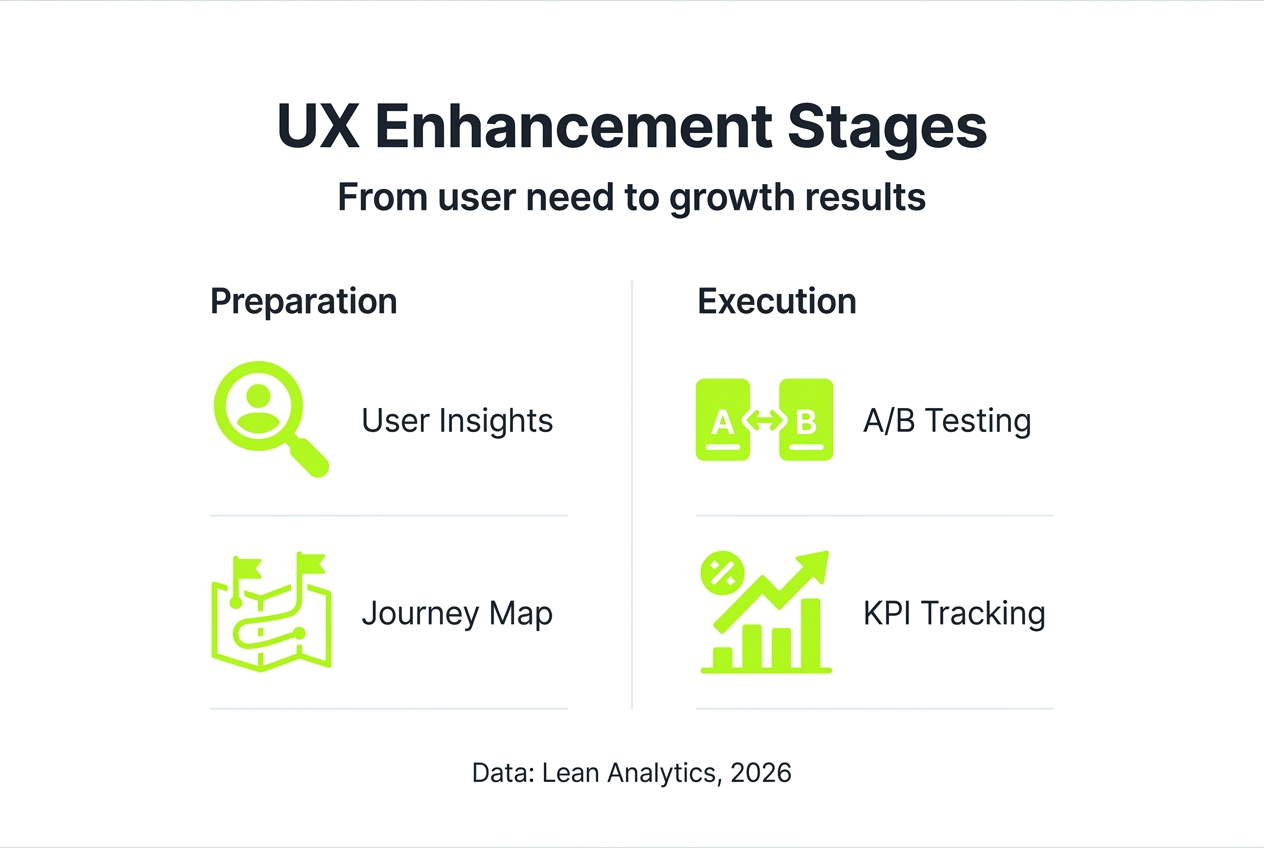
Pro Tip: Set a single North Star metric for your current stage and review it weekly. When that metric hits your target, advance to the next stage. This prevents the common trap of optimizing everything and improving nothing.
Focus creates momentum. Scattered efforts create busy work.
Verification: measuring success and avoiding common UX pitfalls
Implementing changes means nothing without measuring their impact. Track conversion and retention KPIs that align directly with your UX goals. If you improved checkout flow, monitor completion rates. If you enhanced onboarding, track activation metrics.
Companies that allocate 10% of development budget to UX report an 83% increase in conversions. This proves that sustained investment in measurement and iteration pays off exponentially.
Avoid vanity metric traps that look impressive but don't drive business outcomes. Page views mean nothing if bounce rates stay high. Social media followers don't matter if they never convert. Focus ruthlessly on metrics tied to revenue and retention.
Common UX mistakes that kill startup growth:
- Neglecting mobile experience while obsessing over desktop perfection
- Skipping accessibility, limiting your addressable market
- Scaling before validating core UX assumptions
- Tracking too many metrics instead of focusing on one North Star
- Ignoring qualitative feedback in favor of only quantitative data
- Making changes based on personal preference rather than user behavior
Use A/B testing to validate changes objectively. Run one experiment at a time with clear success criteria. Tools like Google Optimize or VWO let you test variations without developer resources. Ensure your sample size is statistically significant before declaring winners.
| Metric Type | What to Track | What to Ignore |
|---|---|---|
| Conversion | Checkout completion, signup rate | Total traffic, page views |
| Engagement | Time on task, feature adoption | Session count, bounce rate |
| Retention | Weekly active users, churn rate | Total registered users |
| Revenue | Customer lifetime value, conversion value | Gross revenue without costs |
Sustain improvements through continuous feedback loops. Monthly user surveys, quarterly usability tests, and ongoing session recording analysis keep you connected to evolving user needs. UX is never finished, it evolves with your product and market.
Implement actionable UX tactics for small businesses by building measurement into every change from the start. Before launching any UX improvement, define exactly how you'll know if it worked.
Pro Tip: Create a simple dashboard showing your top 3 UX metrics updated weekly. Share it with your entire team so everyone understands the current focus and can contribute ideas.
Enhance your digital experience with expert support
Transforming UX from a weakness into a competitive advantage requires both strategy and execution support. Digital Sphere offers tailored digital experience solutions designed specifically for startups and SMEs facing resource constraints.
Our approach combines AI-driven insights with expert human judgment to identify your highest-impact UX opportunities. Through our customer dashboard access, you gain real-time visibility into user behavior patterns and conversion optimization recommendations. We provide personalized project management throughout the improvement process, ensuring changes align with your business goals.
Whether you need responsive website redesign, mobile app optimization, or comprehensive digital strategy, our service packages deliver measurable results without enterprise budgets. Download our UX improvement ebook for frameworks and checklists you can implement immediately.
FAQ
What is the biggest ROI driver in UX enhancement?
UX design investments deliver extraordinary returns, with every $1 invested yielding $100 in business value. Even modest expenditures on user research and interface improvements can generate significant revenue growth through higher conversion rates and customer retention.
How can small businesses gather effective UX insights without large budgets?
Leverage direct contact with your users through simple interviews, surveys, and usability tests. These methods provide insights as valuable as expensive consulting firms deliver. Recording user sessions and analyzing support tickets also reveals friction points at minimal cost.
What are common UX mistakes startups should avoid?
The biggest errors include ignoring mobile-first design when most traffic comes from phones, neglecting accessibility needs that limit your market, and spreading focus across too many metrics before validating core assumptions. Premature scaling and ignoring continuous user feedback also derail UX efforts.
How long does it take to see results from UX improvements?
Simple changes like form optimization or navigation fixes can show conversion lift within days. Comprehensive UX overhauls typically demonstrate measurable impact within 4-8 weeks. The key is implementing changes systematically and measuring specific metrics tied to business outcomes.
Should startups hire a UX designer or use agencies?
This depends on your stage and budget. Early-stage startups benefit from agency expertise that provides strategy plus execution without full-time overhead. As you scale and validate product-market fit, bringing UX talent in-house makes sense for sustained iteration and deep product knowledge.