
Many small businesses invest time and money building a professional website, yet still struggle to attract visitors through search engines. Without proper search engine optimisation, even the best designed sites remain invisible to potential customers. This guide walks you through practical, actionable steps to improve your website's visibility and drive organic traffic in 2026. You will learn how to prepare your site technically, implement proven SEO strategies, and monitor performance to ensure sustained growth. Whether you are just starting or looking to refine your approach, these techniques will help your small business compete effectively online.
Table of Contents
- Preparing Your Website For SEO Success
- Implementing Core SEO Strategies Step-By-Step
- Monitoring Your SEO Performance And Avoiding Common Mistakes
- Get Expert SEO Support With Digital Sphere
- Frequently Asked Questions
Key takeaways
| Point | Details |
|---|---|
| Foundation matters | Technical setup including mobile optimisation and site speed directly impacts search rankings. |
| Keyword strategy | Researching and targeting the right keywords ensures your content reaches your ideal customers. |
| Multi-layered approach | Combining on-page, off-page, and local SEO maximises your visibility across search results. |
| Continuous improvement | Regular monitoring and adjustments keep your SEO performance strong over time. |
Preparing your website for SEO success
Before diving into optimisation tactics, you need to understand where your website currently stands. Start by conducting a comprehensive audit to identify technical issues, content gaps, and opportunities for improvement. Tools like Google Search Console reveal indexing problems, crawl errors, and security issues that could be holding your site back. You should also check for broken links, duplicate content, and outdated pages that dilute your SEO efforts.
Effective SEO begins with a sound technical foundation including site speed and mobile optimisation. In 2026, mobile traffic accounts for over 60% of all web visits, making mobile friendliness non-negotiable. Test your site on multiple devices to ensure responsive design, readable text without zooming, and touch-friendly navigation. Page speed is equally critical, as users abandon sites that take longer than three seconds to load. Compress images, minimise code, enable browser caching, and consider a content delivery network to boost performance.
Keyword research forms the backbone of your entire SEO strategy. Use tools like Google Keyword Planner, Ubersuggest, or SEMrush to identify terms your target audience actually searches for. Focus on long-tail keywords with moderate search volume and lower competition, as these offer quicker wins for small businesses. For example, instead of targeting "plumber," aim for "emergency plumber in Manchester" or "affordable boiler repair near me."
Organise your keywords by search intent:
- Informational: Users seeking knowledge ("how to fix a leaky tap")
- Navigational: Users looking for specific brands or sites ("Bosch boiler manual")
- Transactional: Users ready to purchase ("book plumber today")
- Commercial investigation: Users comparing options ("best plumbers in Leeds reviews")
Create a spreadsheet mapping keywords to specific pages on your site. This ensures each page targets distinct terms without cannibalising your own rankings. Prioritise keywords based on relevance to your business, search volume, and competition level.
| Metric | What it measures | Why it matters |
|---|---|---|
| Search volume | Monthly searches for a keyword | Higher volume means more potential traffic |
| Keyword difficulty | Competition level for ranking | Lower difficulty offers faster results |
| Click-through rate | Percentage of searchers who click results | Indicates commercial intent and opportunity |
| Cost per click | Paid advertising cost for the keyword | Reflects commercial value and competition |
Set up Google Business Profile and Google Analytics immediately if you have not already. These free tools provide essential data about your site's performance, user behaviour, and search visibility. Search Console shows which queries bring visitors to your site, your average position for each keyword, and technical issues requiring attention. Analytics reveals how users navigate your site, which pages perform best, and where visitors drop off.
Pro Tip: Create a baseline report documenting your current rankings, organic traffic, and key metrics before implementing changes. This allows you to measure the real impact of your SEO efforts over time.
Implementing core SEO strategies step-by-step
With your foundation in place, it is time to optimise individual pages for search engines and users. Start with on-page elements that signal relevance to search algorithms. Your title tag should include your primary keyword near the beginning and stay under 60 characters to avoid truncation in search results. Write compelling meta descriptions that summarise page content and include a call to action, keeping them under 155 characters.

Structure your content using header tags (H1, H2, H3) to create a logical hierarchy. Each page should have one H1 tag containing your main keyword, followed by H2 subheadings that break content into digestible sections. Use H3 tags for further subsections when needed. This structure helps search engines understand your content whilst improving readability for visitors.
Create content that genuinely addresses your audience's questions and needs. On-page optimisation and local SEO are critical for small business visibility in search results. Focus on depth over breadth, covering topics thoroughly rather than superficially. Include relevant keywords naturally throughout your text, but prioritise readability over keyword density. Modern search algorithms penalise keyword stuffing and reward content that provides real value.
- Optimise images by compressing file sizes, using descriptive filenames ("red-widget-product.jpg" not "IMG_1234.jpg"), and adding alt text that describes the image content.
- Implement internal linking to connect related pages on your site, helping search engines discover content and keeping visitors engaged longer.
- Add schema markup to help search engines understand your content type, whether it is a product, service, article, or local business listing.
- Create cornerstone content that serves as comprehensive resources on key topics, attracting links and establishing authority.
- Update existing pages regularly to keep information current and signal to search engines that your site remains active and relevant.
Off-page SEO builds your site's authority through external signals, primarily backlinks from other websites. Quality matters far more than quantity, as one link from a respected industry publication carries more weight than dozens from low-quality directories. Focus on earning links through valuable content, guest posting on relevant blogs, and building relationships with complementary businesses.
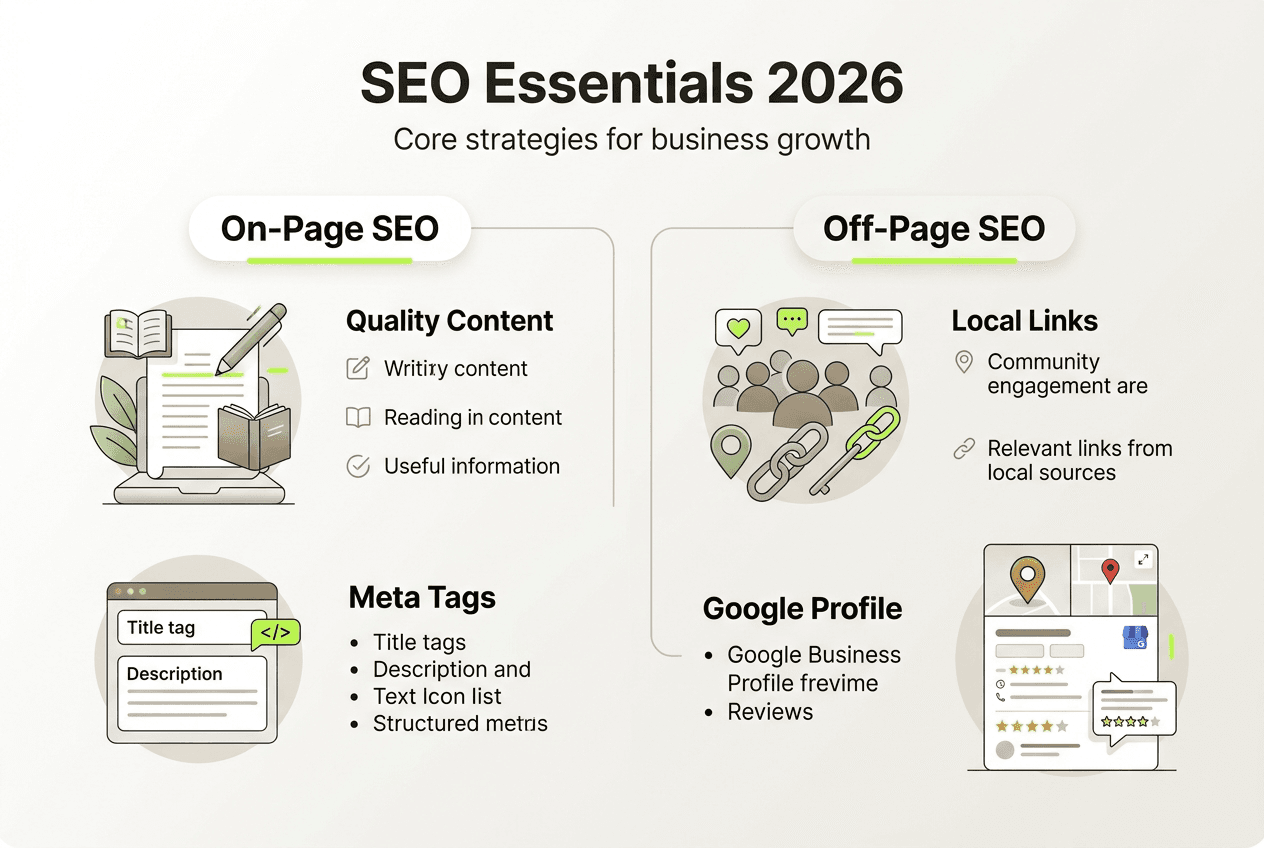
Reach out to local business associations, chambers of commerce, and industry organisations for listing opportunities. Many offer free or low-cost directory listings that provide valuable local backlinks. Create shareable resources like guides, infographics, or research reports that naturally attract links from other sites.
Local SEO deserves special attention for small businesses serving specific geographic areas. Claim and fully optimise your Google Business Profile, ensuring your name, address, and phone number match exactly across all online listings. Add high-quality photos, respond to reviews promptly, and post regular updates about your business.
| Strategy type | Time to results | Effort required | Impact potential |
|---|---|---|---|
| Fix technical errors | 1-2 weeks | Low | Medium |
| Optimise existing content | 2-4 weeks | Medium | High |
| Create new content | 2-3 months | High | High |
| Build quality backlinks | 3-6 months | High | Very high |
| Local listing optimisation | 1-3 weeks | Low | High for local searches |
| Schema markup implementation | 1-2 weeks | Medium | Medium |
Pro Tip: Focus on local SEO strategies if you serve a specific geographic area. Optimising for "near me" searches and local keywords often delivers faster results than competing for broad national terms.
Monitoring your SEO performance and avoiding common mistakes
Implementing SEO tactics is only half the battle. You must track results to understand what works and where to adjust your approach. Google Analytics shows how much organic traffic your site receives, which pages perform best, and how visitors behave once they arrive. Look beyond vanity metrics like total visits to focus on engagement signals such as time on page, pages per session, and conversion rates.
Google Search Console provides search-specific insights that Analytics cannot. Review your Performance report weekly to see which queries drive impressions and clicks, your average position for each keyword, and click-through rates. If impressions are high but clicks are low, your meta descriptions may need improvement. If you rank well but receive little traffic, you might be targeting keywords with low search volume.
Watch for these common SEO mistakes that undermine small business websites:
- Keyword stuffing: Overusing keywords makes content unreadable and triggers search engine penalties
- Ignoring mobile users: Failing to optimise for mobile devices alienates the majority of web traffic
- Slow page speed: Every second of load time reduces conversions and increases bounce rates
- Duplicate content: Copying content from other sites or duplicating your own pages confuses search engines
- Neglecting local signals: Missing or inconsistent business information reduces local search visibility
- Broken links: Dead links frustrate users and waste the link equity you have worked to build
Regular monitoring and error correction are essential to sustain SEO success. Set up automated alerts in Search Console to notify you of critical issues like manual penalties, security problems, or dramatic ranking drops. Check your site monthly for broken links using tools like Screaming Frog or Ahrefs, and fix or redirect them promptly.
Content freshness matters more in 2026 than ever before. Search engines favour sites that regularly update information, especially for topics where accuracy matters. Review your top-performing pages quarterly and refresh statistics, examples, and recommendations to keep them current. Add new sections addressing emerging questions or trends in your industry.
Technical SEO requires ongoing attention as search engine algorithms evolve. Ensure your XML sitemap remains updated and submitted to Search Console. Check that your robots.txt file does not accidentally block important pages. Monitor your site's indexing status to catch issues where pages fail to appear in search results.
"SEO is not a one-time project but an ongoing process of refinement and adaptation. The businesses that succeed are those that treat optimisation as a continuous commitment rather than a checkbox to tick."
If your rankings suddenly drop, investigate immediately. Check Search Console for manual actions or algorithm update impacts. Review recent changes to your site that might have introduced technical issues. Analyse competitor sites that outrank you to identify gaps in your own content or backlink profile. Sometimes rankings fluctuate naturally, but persistent drops require action.
Pro Tip: Create a monthly SEO monitoring routine that includes checking rankings for your top 20 keywords, reviewing Analytics for traffic trends, auditing new content for optimisation, and scanning for technical errors. Consistency in monitoring leads to faster problem detection and resolution.
Get expert SEO support with Digital Sphere
Whilst these strategies provide a solid foundation, executing comprehensive SEO whilst running your business can feel overwhelming. Digital Sphere specialises in helping small businesses maximise their online visibility through tailored SEO solutions. Our team combines technical expertise with industry knowledge to create strategies that deliver measurable results.
We handle everything from technical audits and keyword research to content optimisation and link building, allowing you to focus on serving your customers. Our personalised approach means you receive strategies designed specifically for your business goals and target audience, not generic templates. Access practical resources like our SEO optimisation ebook to deepen your understanding, or explore our Google Business Profile guide to strengthen your local search presence. Let us partner with you to build lasting digital success.
Frequently asked questions
How long does it take to see results from SEO?
SEO results typically begin to show within three to six months, though this varies based on your industry's competitiveness and your site's current authority. Quick wins like fixing technical errors or optimising existing high-traffic pages can show improvements within weeks. Building significant organic traffic through new content and backlinks requires sustained effort over several months. Local SEO improvements often appear faster than national campaigns, especially when you optimise your Google Business Profile and local citations. Consistency matters more than speed, as maintaining your SEO efforts compounds results over time.
What are the most important SEO factors for small businesses?
Site speed and mobile friendliness top the list, as Google prioritises user experience in rankings. Creating relevant, high-quality content that addresses your customers' actual questions builds authority and attracts organic traffic. Local SEO elements like Google Business Profile optimisation and consistent business citations are crucial if you serve a specific geographic area. Quality backlinks from authoritative sites in your industry signal trustworthiness to search engines. Keyword targeting ensures you appear for searches that matter to your business, whilst technical SEO keeps your site crawlable and indexable.
What common SEO mistakes should I avoid?
Keyword stuffing makes content unreadable and can trigger search engine penalties, so use keywords naturally within valuable content. Ignoring mobile users alienates over 60% of web traffic and hurts your rankings, as Google uses mobile-first indexing. Slow page speed frustrates visitors and reduces conversions, so optimise images and minimise code. Duplicate content confuses search engines about which version to rank, diluting your visibility. Neglecting regular audits allows technical errors and broken links to accumulate, gradually eroding your search performance. Fix issues promptly when you discover them rather than letting problems compound.
How can I keep up with SEO changes in 2026?
Follow official Google Search Central blog and documentation for authoritative updates directly from the source. Subscribe to reputable SEO publications like Search Engine Journal, Moz, and Search Engine Land for industry analysis and practical advice. Join small business forums and local marketing groups where peers share experiences and strategies. Consider investing in professional training through courses or workshops to build your SEO knowledge systematically. Working with experienced consultants or agencies provides access to expertise whilst keeping you informed about important changes. The SEO landscape evolves constantly, so dedicate time monthly to learning and adapting your approach.